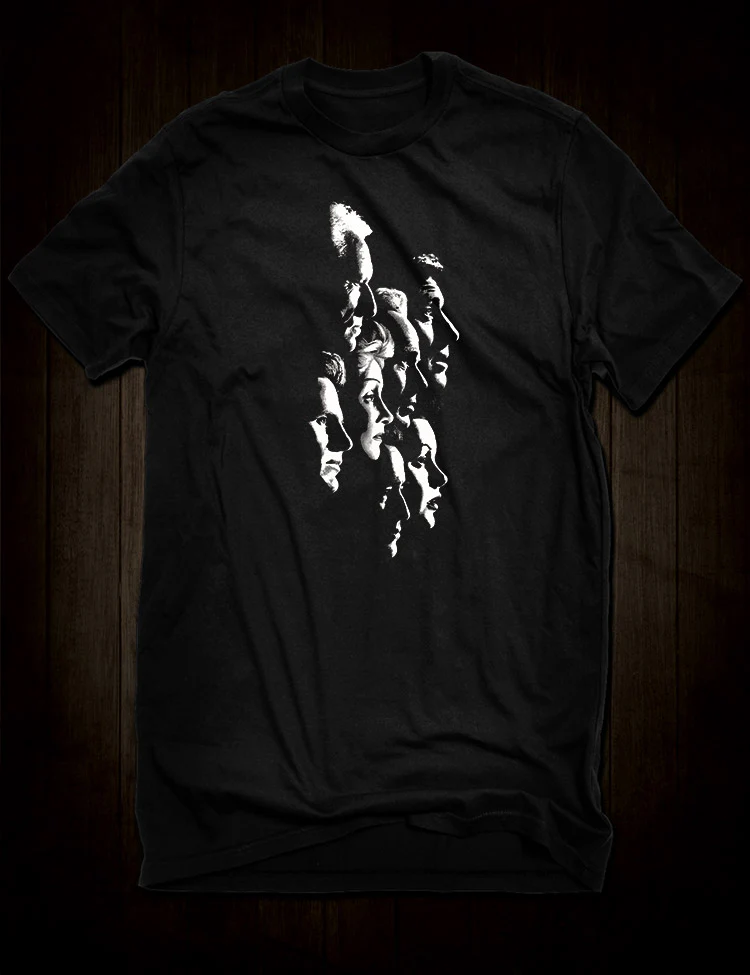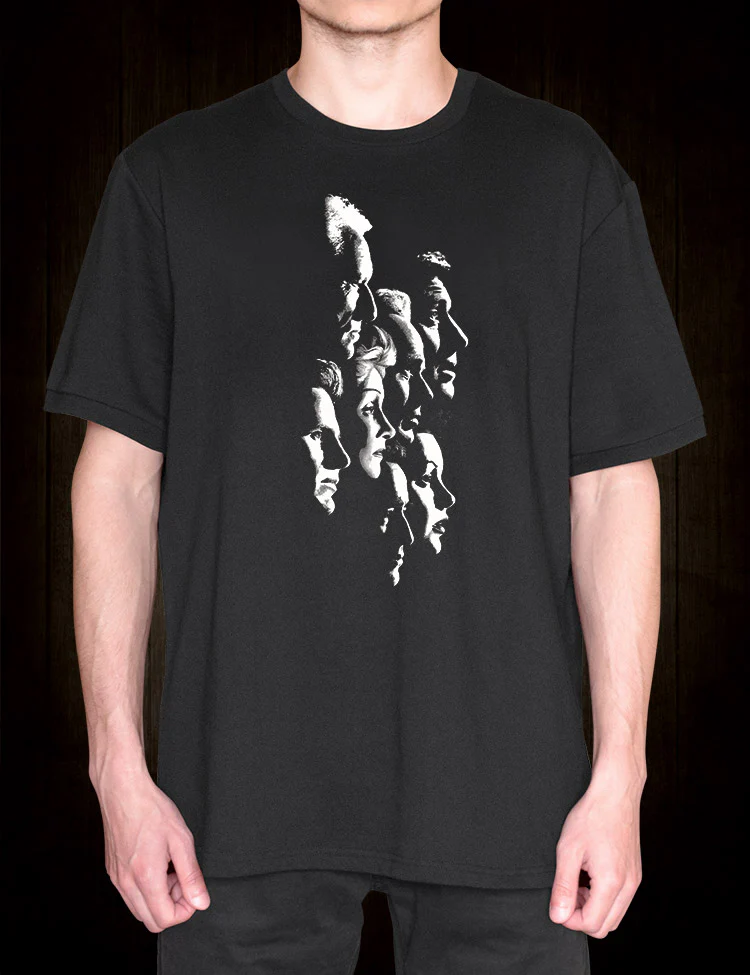
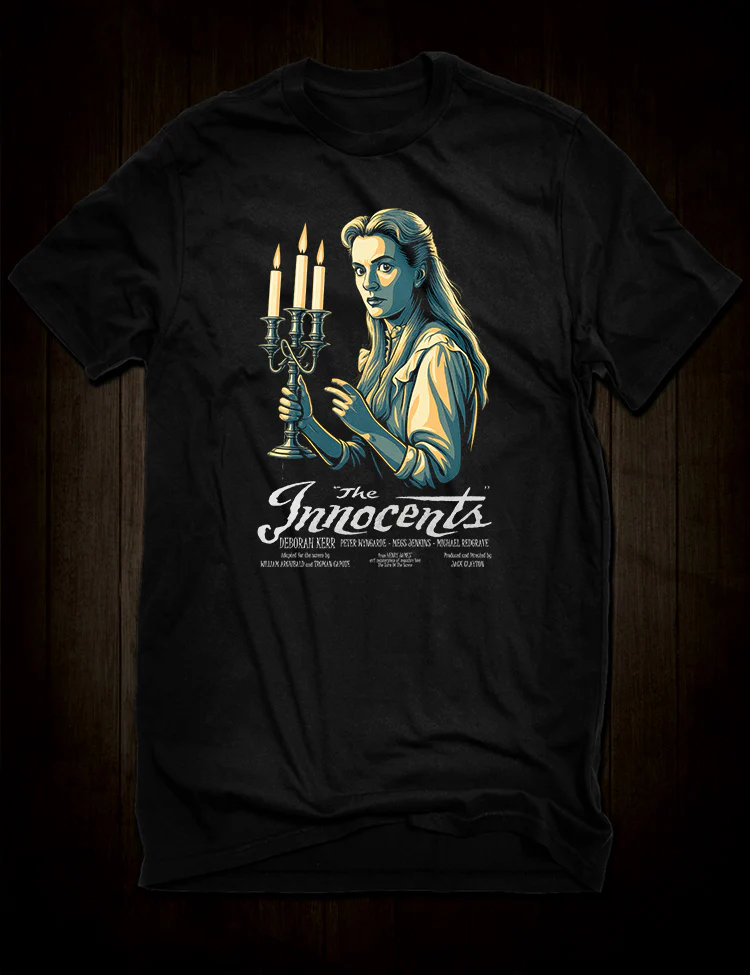
The Innocents T-Shirt
THE INNOCENTS T-SHIRT
A Classic Movie T-Shirt Available in Black Cotton.
Deep within the damp, ivy-strangled stones of Bly House, a chilling ambiguity breathes behind every velvet curtain. Jack Clayton’s 1961 masterpiece, The Innocents, remains the definitive cinematic translation of Henry James’s The Turn of the Screw, a psychological ghost story that trades jump-scares for a suffocating, sun-drenched dread. As the high-strung Miss Giddens, Deborah Kerr delivers a performance of frayed nerves and frantic devotion, arriving at the remote estate to care for two ethereal children, Miles and Flora. What she finds is not a sanctuary, but a spectral playground where the boundary between the living and the lecherous dead has grown perilously thin.
The film is a triumph of Gothic horror cinematography, captured in the stark, silver-hued depths of CinemaScope by Freddie Francis. It eschews the garish gore of its contemporaries, opting instead for the unsettling presence of Peter Quint and Miss Jessel—figures who appear not in the darkness, but in the blinding clarity of a summer afternoon or across the black mirror of a lily-choked pond. This is a narrative of possession, perhaps by spirits, or perhaps by the repressed psychosexual anxieties of the Victorian era. The "innocents" of the title are a riddle; are they victims of a supernatural corruption, or are they the architects of their governess's spiraling descent into madness?
"The laughter of children is the most beautiful sound in the world... unless it’s the only sound you hear in a house you thought was empty." — Promotion Tagline (1961)
The Innocents is a cornerstone of cult cinema, lauded for its sophisticated sound design—a cacophony of whispering reeds and distant, distorted nursery rhymes—and its screenplay, co-written by Truman Capote. It captures a specific brand of literary horror that feels both antique and avant-garde. To wear this design is to align oneself with the connoisseurs of the uncanny. It is a nod to the era of the grand psychological thriller, where the true monster is the uncertainty that lingers after the candles have been snuffed out. This isn't just a film; it’s a haunting that refuses to leave the room.
💬 FREQUENTLY ASKED QUESTIONS (FAQs)
Q1: What is the significance of the "willows" and the pond in the film's imagery?
A1: The pond represents the stagnant, suffocating past of Bly House. It is where the ghost of Miss Jessel first appears to Miss Giddens, symbolizing the "drowning" of innocence and the dark reflection of the characters' repressed emotions.
Q2: Did Truman Capote really write the screenplay for this film?
A2: Yes. Capote was brought in specifically to inject the script with "Southern Gothic" sensibilities and a heightened sense of psychological unease, resulting in the film's uniquely lyrical and disturbing dialogue.
Q3: Is the film's haunting meant to be real or a hallucination?
A3: This remains one of cinema's greatest debates. The film is shot entirely from Miss Giddens' perspective, leaving it up to the viewer to decide if the ghosts are external entities or manifestations of her own fracturing psyche.
THE INNOCENTS T-SHIRT
A Classic Movie T-Shirt Available in Black Cotton.
Deep within the damp, ivy-strangled stones of Bly House, a chilling ambiguity breathes behind every velvet curtain. Jack Clayton’s 1961 masterpiece, The Innocents, remains the definitive cinematic translation of Henry James’s The Turn of the Screw, a psychological ghost story that trades jump-scares for a suffocating, sun-drenched dread. As the high-strung Miss Giddens, Deborah Kerr delivers a performance of frayed nerves and frantic devotion, arriving at the remote estate to care for two ethereal children, Miles and Flora. What she finds is not a sanctuary, but a spectral playground where the boundary between the living and the lecherous dead has grown perilously thin.
The film is a triumph of Gothic horror cinematography, captured in the stark, silver-hued depths of CinemaScope by Freddie Francis. It eschews the garish gore of its contemporaries, opting instead for the unsettling presence of Peter Quint and Miss Jessel—figures who appear not in the darkness, but in the blinding clarity of a summer afternoon or across the black mirror of a lily-choked pond. This is a narrative of possession, perhaps by spirits, or perhaps by the repressed psychosexual anxieties of the Victorian era. The "innocents" of the title are a riddle; are they victims of a supernatural corruption, or are they the architects of their governess's spiraling descent into madness?
"The laughter of children is the most beautiful sound in the world... unless it’s the only sound you hear in a house you thought was empty." — Promotion Tagline (1961)
The Innocents is a cornerstone of cult cinema, lauded for its sophisticated sound design—a cacophony of whispering reeds and distant, distorted nursery rhymes—and its screenplay, co-written by Truman Capote. It captures a specific brand of literary horror that feels both antique and avant-garde. To wear this design is to align oneself with the connoisseurs of the uncanny. It is a nod to the era of the grand psychological thriller, where the true monster is the uncertainty that lingers after the candles have been snuffed out. This isn't just a film; it’s a haunting that refuses to leave the room.
💬 FREQUENTLY ASKED QUESTIONS (FAQs)
Q1: What is the significance of the "willows" and the pond in the film's imagery?
A1: The pond represents the stagnant, suffocating past of Bly House. It is where the ghost of Miss Jessel first appears to Miss Giddens, symbolizing the "drowning" of innocence and the dark reflection of the characters' repressed emotions.
Q2: Did Truman Capote really write the screenplay for this film?
A2: Yes. Capote was brought in specifically to inject the script with "Southern Gothic" sensibilities and a heightened sense of psychological unease, resulting in the film's uniquely lyrical and disturbing dialogue.
Q3: Is the film's haunting meant to be real or a hallucination?
A3: This remains one of cinema's greatest debates. The film is shot entirely from Miss Giddens' perspective, leaving it up to the viewer to decide if the ghosts are external entities or manifestations of her own fracturing psyche.
Original: $20.00
-70%$20.00
$6.00Description
THE INNOCENTS T-SHIRT
A Classic Movie T-Shirt Available in Black Cotton.
Deep within the damp, ivy-strangled stones of Bly House, a chilling ambiguity breathes behind every velvet curtain. Jack Clayton’s 1961 masterpiece, The Innocents, remains the definitive cinematic translation of Henry James’s The Turn of the Screw, a psychological ghost story that trades jump-scares for a suffocating, sun-drenched dread. As the high-strung Miss Giddens, Deborah Kerr delivers a performance of frayed nerves and frantic devotion, arriving at the remote estate to care for two ethereal children, Miles and Flora. What she finds is not a sanctuary, but a spectral playground where the boundary between the living and the lecherous dead has grown perilously thin.
The film is a triumph of Gothic horror cinematography, captured in the stark, silver-hued depths of CinemaScope by Freddie Francis. It eschews the garish gore of its contemporaries, opting instead for the unsettling presence of Peter Quint and Miss Jessel—figures who appear not in the darkness, but in the blinding clarity of a summer afternoon or across the black mirror of a lily-choked pond. This is a narrative of possession, perhaps by spirits, or perhaps by the repressed psychosexual anxieties of the Victorian era. The "innocents" of the title are a riddle; are they victims of a supernatural corruption, or are they the architects of their governess's spiraling descent into madness?
"The laughter of children is the most beautiful sound in the world... unless it’s the only sound you hear in a house you thought was empty." — Promotion Tagline (1961)
The Innocents is a cornerstone of cult cinema, lauded for its sophisticated sound design—a cacophony of whispering reeds and distant, distorted nursery rhymes—and its screenplay, co-written by Truman Capote. It captures a specific brand of literary horror that feels both antique and avant-garde. To wear this design is to align oneself with the connoisseurs of the uncanny. It is a nod to the era of the grand psychological thriller, where the true monster is the uncertainty that lingers after the candles have been snuffed out. This isn't just a film; it’s a haunting that refuses to leave the room.
💬 FREQUENTLY ASKED QUESTIONS (FAQs)
Q1: What is the significance of the "willows" and the pond in the film's imagery?
A1: The pond represents the stagnant, suffocating past of Bly House. It is where the ghost of Miss Jessel first appears to Miss Giddens, symbolizing the "drowning" of innocence and the dark reflection of the characters' repressed emotions.
Q2: Did Truman Capote really write the screenplay for this film?
A2: Yes. Capote was brought in specifically to inject the script with "Southern Gothic" sensibilities and a heightened sense of psychological unease, resulting in the film's uniquely lyrical and disturbing dialogue.
Q3: Is the film's haunting meant to be real or a hallucination?
A3: This remains one of cinema's greatest debates. The film is shot entirely from Miss Giddens' perspective, leaving it up to the viewer to decide if the ghosts are external entities or manifestations of her own fracturing psyche.